The Exemption Already Exists. Washington Just Needs to Apply It Twice.
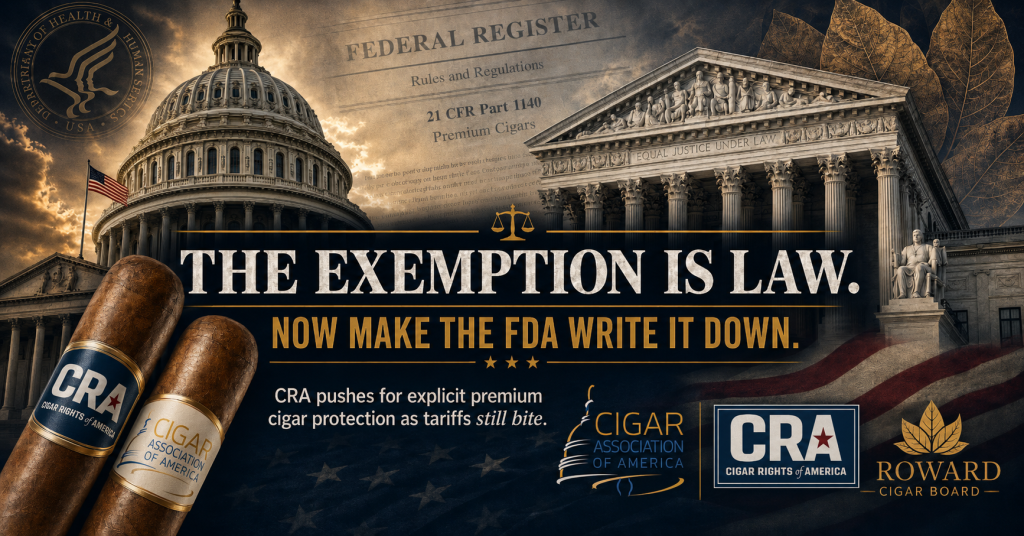
Premium cigars are not regulated by the FDA. That is not an argument, not a request, and not a pending proposal. It is the law, decided in federal court, and it is the single most important thing the premium cigar industry has won in a decade.
So when the FDA proposed a new rule in July requiring tobacco manufacturers to register their establishments and submit product listings, Cigar Rights of America did not go to Washington asking for an exemption. They went asking for something narrower and, in a way, more revealing. CRA says it will submit comments urging the FDA to make sure the final rule “expressly recognizes the current premium cigar exemption and does not create uncertainty for premium cigar manufacturers, importers, retailers, or foreign production partners.”
Read that again. The exemption is already won. CRA is spending its comment period making sure the agency writes it down.
That is not paranoia. That is what you do when you have watched a category get swept into a regulatory framework once already and you understand that silence in a federal rule is not the same as protection. A rule that says nothing about premium cigars is a rule that a future administration, a future general counsel, or a foreign production partner’s compliance department can read whatever way it wants. CRA is asking for a sentence. The sentence matters.
Here is where it gets frustrating.
The same government that exempted cigars from FDA regulation could not find room for them in a single tariff exemption.
We read all 431 pages of the Section 301 action that took effect July 24. Chapter 24 tobacco appears in no exemption anywhere. Twelve and a half percent, on Dominican and Nicaraguan cigars, with no carve-out.
The logic that won the FDA case is the same logic that should have won the tariff case. Premium cigars are a distinct product category. They are not cigarettes. They are not a public health mass-market product. And as CAA President Scott Pearce told the Section 301 Committee in the hearing we covered in July, nearly 99 percent of large cigars sold in the United States are imported, with Honduras, the Dominican Republic, and Nicaragua supplying more than 98 percent of that. There is no domestic premium cigar industry for a tariff to protect. A tariff here does not shield an American factory. It taxes an American retailer.
CRA is making the same case at USTR that it made in court, and it is making it on labor grounds too — arguing that premium cigar producers operate transparent, traceable workplaces and that the forced-labor concerns driving the Section 301 review do not describe this supply chain.
The court agreed that premium cigars are different. The trade office has not. Same product, same argument, two federal agencies, opposite answers.
That is the part worth sitting with. The industry did not win a favor in the FDA case. It won a finding — that this category behaves differently, is consumed differently, and does not belong in a framework built for something else. A finding like that ought to travel. Right now it does not, and the gap between those two outcomes is being paid for at the register in Fort Lauderdale, in Tampa, in every shop that just watched its cost basis move.
The FDA comment window closes September 14. CRA will file. It is worth filing too — the comment portal is open to anyone, and a retailer describing what a twelve percent cost increase actually does to a small business reads differently than a trade association letter.
One sentence in a federal rule is what stands between a settled exemption and a decade of ambiguity. The tariff fight is proof of what happens when nobody writes the sentence down.
Retailers — has the 12.5 percent hit your shelf pricing yet, or are you still eating it?

About Julian Spring
Julian Spring is the founder and editor of Broward Cigar Board, covering premium cigar news, releases, and reviews since 2019. Based in South Florida, he hosts community events with premium cigar brands, local retailers, and leads an 11,000+ member cigar community across Instagram and Facebook. Reach him at press@browardcigarboard.com.
Discover more from Broward Cigar Board
Subscribe to get the latest posts sent to your email.