Cigars Were Left Out of Every Exemption. Here Is What That Costs You.
The tariff went live at 12:01 a.m. Friday, and premium cigars did not get a carve-out.
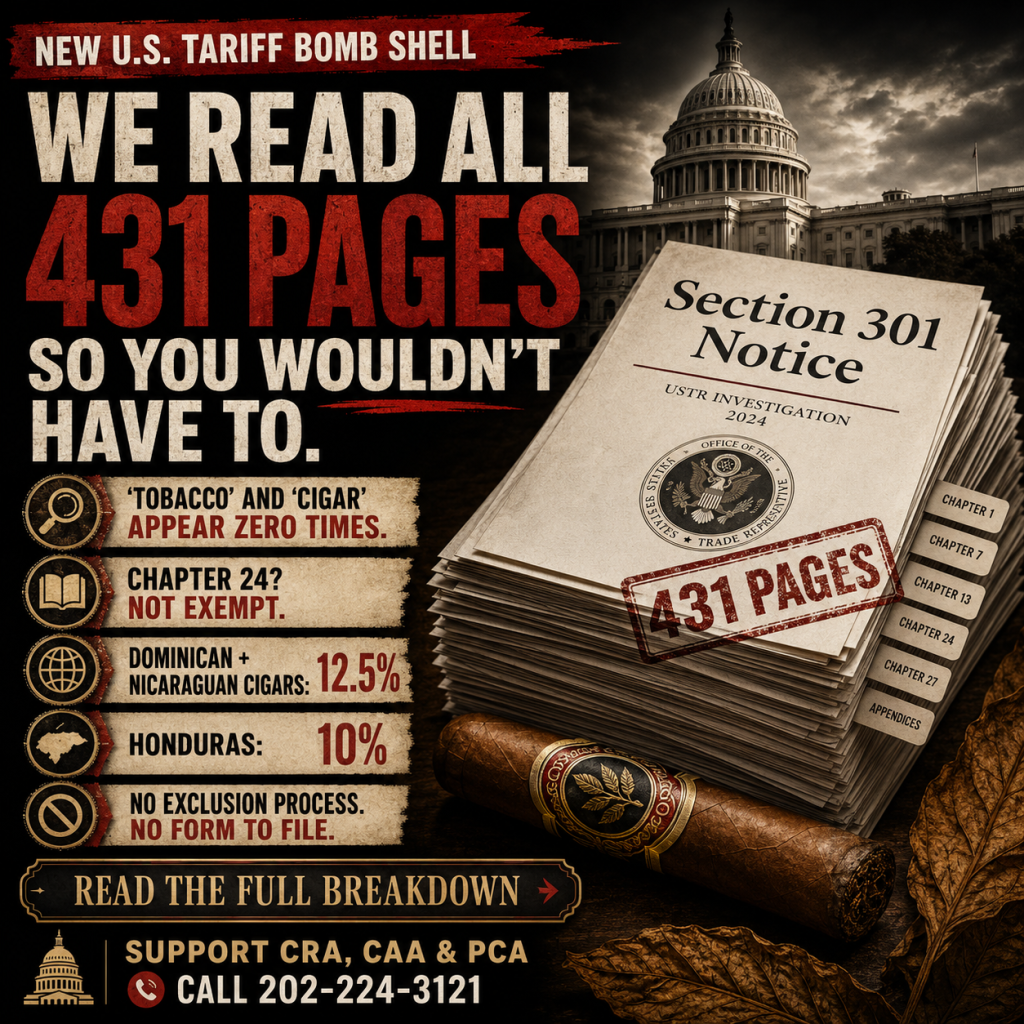
On July 23, U.S. Trade Representative Jamieson Greer took final action under Section 301 of the Trade Act of 1974, imposing duties on 60 economies for their “failure to impose and effectively enforce a prohibition on the importation of goods produced with forced labor.” The Dominican Republic and Nicaragua drew 12.5 percent. Honduras drew 10 percent. Duties apply to goods entered on or after 12:01 a.m. eastern July 24, with cargo in transit spared if it clears before July 28.
Honduras got the lower number for a reason USTR states plainly: “its adoption of a forced labor import prohibition subsequent to the publication of the June 5, 2026 FRN.” Cambodia, Guatemala, India, Sri Lanka, and Trinidad and Tobago earned the same discount. Pass the law, drop 2.5 points. Managua and Santo Domingo did not.
What the document says about cigars
Nothing. That is the finding.
BCB read all 431 pages. The words “tobacco” and “cigar” do not appear once. No Chapter 24 heading — 2401, 2402, or 2403 — appears in the notice, in Annex I, or in any Part of Annex II.
The absence is louder in context. Annex II Part A, the exemption list covering every investigated economy, spares an enormous amount of agriculture: beef, coffee, spices, cocoa, beverages. It covers every chapter from 1 through 23, skips 24, and resumes at 25. Tobacco is the hole in the middle of the agricultural carve-out.
USTR’s criteria include relief for goods that “cannot be grown or produced in sufficient quantities or at reasonable prices in the United States.” Premium cigars fit that better than much of what was exempted. The CAFTA-DR exemption cited elsewhere is Part O, covering textile and apparel goods of Jordan, El Salvador, and Guatemala. It does nothing for a cigar.
Nobody accused a cigar factory of anything
The finding is against governments, not producers. USTR leans on Section 301(c)(3)(B), which permits action against goods “without regard to whether or not such goods or economic sector were involved in the act, policy, or practice.” The statute allows it. That is the part worth contesting. A torcedor in Estelí cannot move a legislature in Managua, and neither can the shop on Federal Highway that sells his work.
The door USTR closed
Commenters asked for a product exclusion process. USTR refused: “Establishing an exclusion process that would result in lowering of tariffs on additional products would be inconsistent with the President’s direction.” Review requests were pointed to Section 307 of the Trade Act, 19 U.S.C. 2417.
There is no form to file. No exclusion docket. The only path left is Section 307 modification, discretionary to USTR and the President. It moves under political pressure and not otherwise.
What we are asking you to do
Support the groups built for this. Cigar Rights of America and the Cigar Association of America have carried federal tariff and regulatory fights for years, and the Premium Cigar Association represents the retailers absorbing this first. Join, renew, or donate. Their leverage is a function of how many of us stand behind them.
Then make two asks of your Representative and both Senators. First, press USTR to use its Section 307 authority and exempt Chapter 24 under USTR’s own “not produced in sufficient quantities in the United States” criterion. Second, push USTR and State to help the Dominican Republic and Nicaragua adopt forced labor import prohibitions. Honduras proved that path drops the rate.
Capitol switchboard is 202-224-3121. Be specific. Say Section 301, forced labor investigation, Chapter 24. Vague opposition gets filed. A specific ask gets logged.
We do not run political posts often. This one is already on your shelf price.
Shop owners: absorbing this through the fall, or does it hit the tag in August?

About Julian Spring
Julian Spring is the founder and editor of Broward Cigar Board, covering premium cigar news, releases, and reviews since 2019. Based in South Florida, he hosts community events with premium cigar brands, local retailers, and leads an 11,000+ member cigar community across Instagram and Facebook. Reach him at press@browardcigarboard.com.
Discover more from Broward Cigar Board
Subscribe to get the latest posts sent to your email.